When you are considering new automation for your greenhouse, it is not enough to look only at the labour hours a robot can save. You should also ask: Can it remove a bottleneck, keep production moving and free employees to focus on work that requires their experience and technical skills?
That is often where the investment begins to deliver its real return.
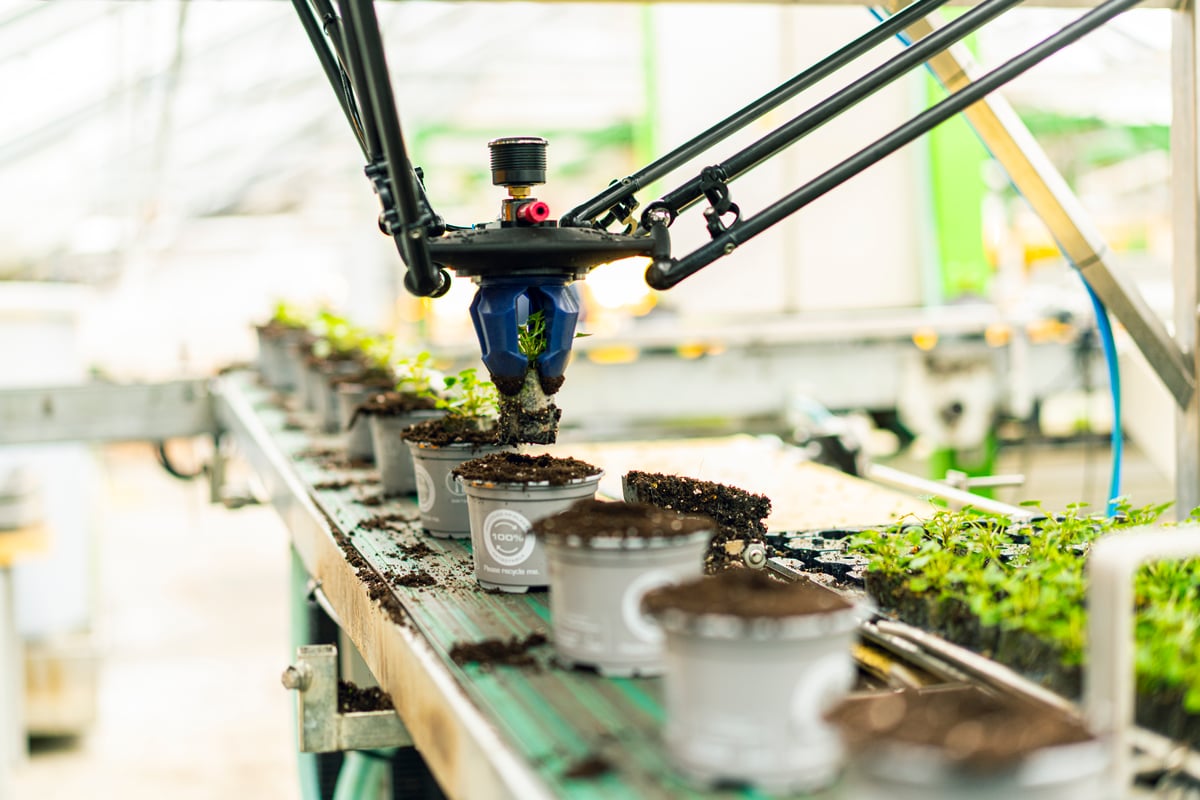
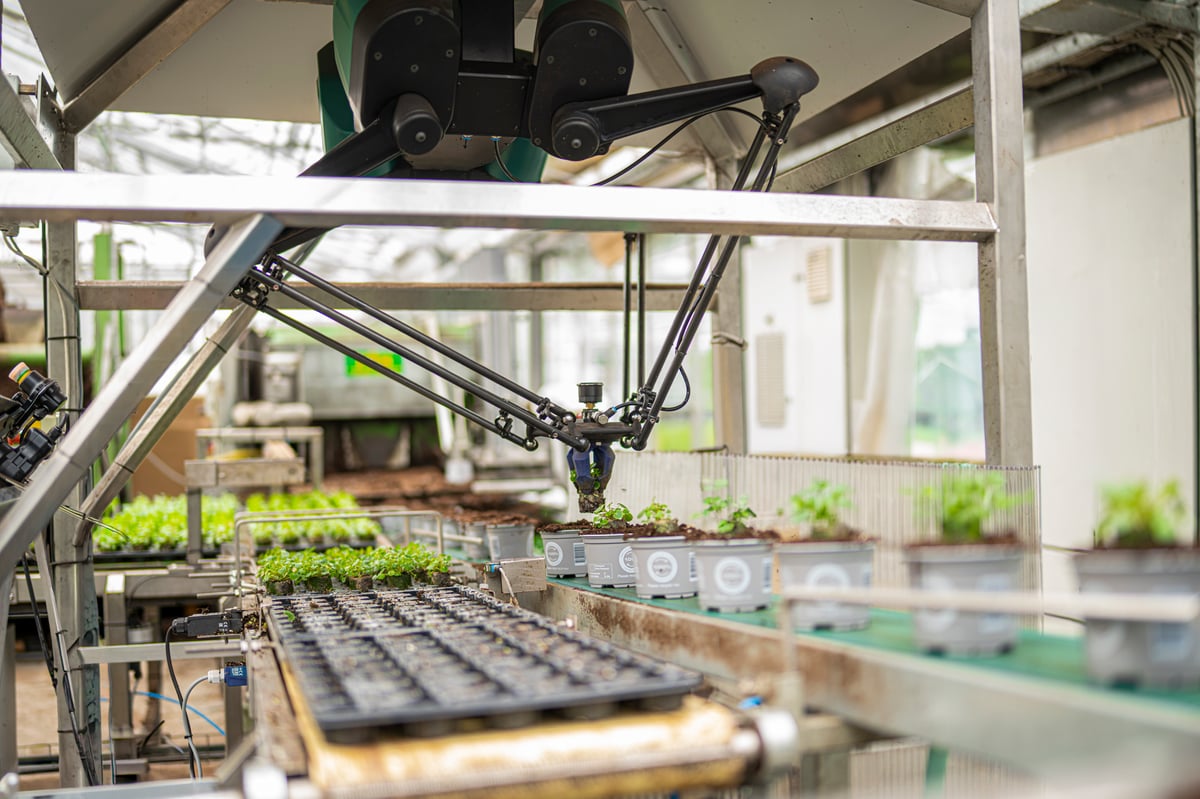
At Goodness Gardens, a fresh basil producer in New York, four collaborative robots from 4XROBOTS have taken over a physically demanding process that had the potential to become a production bottleneck.
Why did the investment make sense?
Not only because of the labour hours saved. Since the process was automated, twice as many growing gutters can be cleared in the same amount of time. Employees can focus on other work where their skills create more value, and production has become more stable and easier to plan.
It is this wider calculation that matters when you assess whether an investment in your greenhouse operation will pay off.
An ROI analysis starts at the bottleneck
Goodness Gardens is one of the largest fresh basil producers in the United States. In the FGM moving gutter system where the plants are grown, employees previously had to remove plant material and roots from the growing gutters by hand after the basil had been harvested.
The job was messy and repetitive. If too few people were available to do it, used gutters could build up and delay the rest of production.
Today, four collaborative robots from 4XROBOTS perform the task as part of an integrated solution with FGM's moving gutter system.
For Goodness Gardens founder and President Brian Murphy, the installation is a practical example of why automation should be considered as part of production design from the outset, rather than only when labour or capacity becomes critical.
|
BRIAN MURPHY, FOUNDER AND PRESIDENT, GOODNESS GARDENS “Make sure you plan it in the beginning with the robots. It'll make your life a lot easier.” |
The point is financial, but it is also operational. When automation removes a bottleneck, its value is not limited to the hours saved. It can change the capacity and flow of the wider production system. That is what Goodness Gardens has experienced.
Higher efficiency with the same resources
At Goodness Gardens, the effect on the specific process is clear: twice as many growing gutters are now cleared in the same amount of time.
Brian Murphy also reports that overall labour productivity at the company's most automated greenhouse has increased by 50% following its work to optimise the growing system. The robots are one part of that broader improvement.
This distinction matters when a grower calculates how quickly an investment may pay back. Automation can create value at several levels at once:
- More units moving through production
- Fewer manual hours per unit produced
- Less risk of stoppages and bottlenecks
- More consistent processes
- Better use of existing employees' skills
The true business case is therefore not always captured by simply comparing the investment with the salary of one employee and multiplying the result.
|
NICK CHAMBERS, HEAD OF MARKET DEVELOPMENT & INSIGHT, 4XROBOTS “A sound calculation does not begin only with the labour hours a robot can take over. We also look at whether automation can remove a bottleneck, increase capacity and make production more stable. It is the combined effect across the greenhouse that determines whether the investment makes sense.” |
Predictability has economic value
Robots offer another benefit that is harder to price in isolation: they make capacity more predictable.
At Goodness Gardens, the robots perform the process at a consistent pace. That makes the surrounding greenhouse production easier to plan, particularly when demand and labour availability vary by season.
Automation can therefore generate a return even when the immediate reduction in labour hours does not tell the whole story. Fewer interruptions, better flow and more stable capacity can be just as important to the overall economics of the business.
The central question is not only: How many hours can the robot save?
It is also: What happens to the rest of production when it does?
What to include in an automation payback calculation?
Start with one clearly defined process. Compare the current state with a realistic automated state, using your own production data and assumptions.
| Factor | Include in the calculation |
|
Upfront investment |
Robot equipment, tooling, integration, installation, commissioning, training and any financing costs. |
|
Labour effect |
Hours per shift, fully loaded labour cost, overtime, recruitment pressure and the value of redeploying employees to skilled work. |
|
Capacity effect |
Units per hour, bottleneck removal, line utilisation and the contribution from additional saleable output. |
|
Flow and risk |
Stoppages, waiting time, process variability, rework, waste and other avoidable operating costs relevant to the application. |
|
Annual operating cost |
Maintenance, service, energy, consumables, software and any recurring integration or support costs. |
|
Realistic utilisation |
Operating days, shifts, seasonality, ramp-up time, planned maintenance and expected availability. |
|
SIMPLE PAYBACK FORMULA Annual net benefit = labour and operating savings + contribution from additional saleable output + avoided costs - added annual operating costs. |
Want to know where automation could create the most value in your production? Talk to a 4XROBOTS specialist about your workflow and the assumptions behind a realistic business case.
Learn more about collaborative robots developed for greenhouse production