
For Evan Sharples of FGM, the starting point is not necessarily how much the greenhouse can be automated in one go. It is identifying the individual processes where automation can make a practical difference.
“Growers don’t have to automate an entire facility to get started with collaborative robotics. The better questions are often: Where do we have a repetitive process today? Where could a robot make an immediate difference in production? Start there, prove the value and build from that experience,” says Evan Sharples.
A more accessible way to start automation
One of the biggest barriers to automation is often the investment.
Greenhouse businesses have traditionally been accustomed to considering automation when building a new facility or making major upgrades to an existing one. That can make robotics seem like a decision that has to wait until the next major development project.
Modular automation offers another way.
A collaborative robot can be introduced to automate one specific process within an existing greenhouse without necessarily requiring a major redesign of the entire operation.
That reduces both the scope and the initial investment compared with a large, fully integrated automation project.
“Automation shouldn’t automatically mean rebuilding the greenhouse. If we can integrate a robot into an existing production flow and solve one meaningful problem, the investment becomes much easier to evaluate and manage,” says Evan Sharples.
Start with the process, not the robot
The first step is understanding what happens on the greenhouse floor during daily production.
The most relevant applications are often repetitive manual jobs: tasks that require employees to perform the same movements or handling operations throughout the day.
Those are processes where collaborative robots can potentially take over the repetition while employees focus on work that requires horticultural knowledge, judgement and flexibility.
For growers, this also makes the investment case easier to understand. Rather than buying automation for automation’s sake, the robot is introduced to address a clearly identified operational need.
“The technology should fit the operation, not the other way around. We look for processes where the work is repetitive - where taking that task away from an employee can improve both the workflow and how people’s time is best spent in the greenhouse,” says Sharples.
One robot can do more than one job
Modularity is not only about adding more robots.
A collaborative robot can also be adapted to different tasks by changing its end-of-arm tool. That opens the possibility of using the same robot for one application during part of the day and another task later.
For greenhouse operations where workloads and labor requirements change by crop, season or time of day, that flexibility can be significant.
It also means the investment does not necessarily have to remain tied to one task throughout the robot’s working life.
“Greenhouse production changes, so automation needs to be flexible as well. Being able to change the tool or redeploy a robot gives growers more options to use the same investment where it creates the most value,” says Sharples.
Start with one robot and scale when needed
A key advantage of modular automation is that growers do not need to know what the final system will look like on day one.
An operation can begin with one robot performing one task. If production expands or the grower identifies additional opportunities, more robots can be added later.
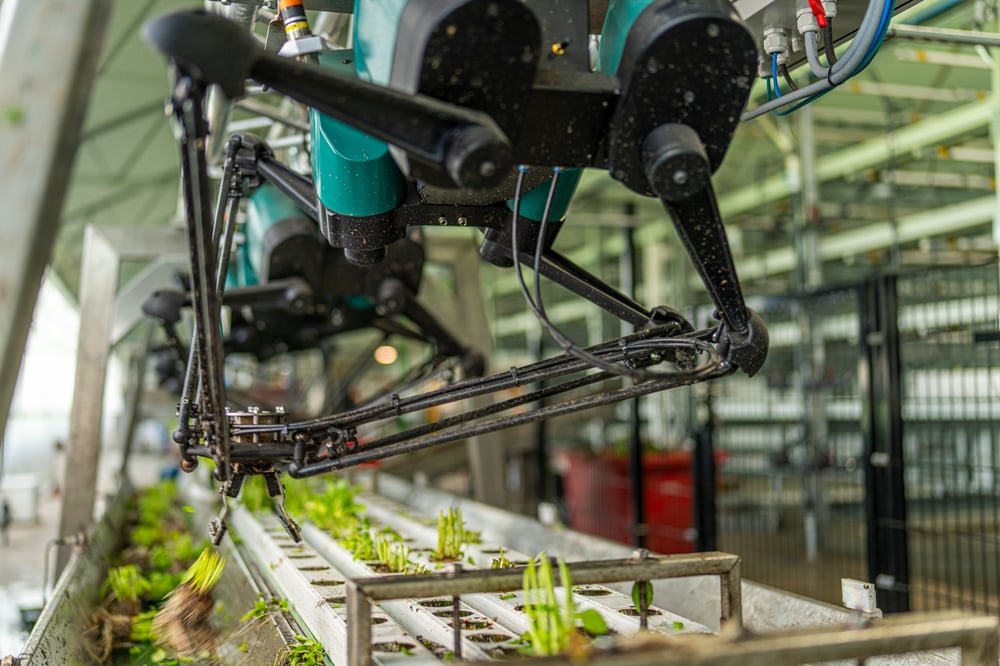
Goodness Garden in New York provides one example. Four collaborative robots from 4XROBOTS are integrated into an FGM Moving Gutter System, where they automate a process that previously had the potential to become a bottleneck. Following automation, the process handles twice as many growing gutters as before.
The important point is not that every grower needs four robots. It is that they do not need to start with four.
“There is a lot of value in being able to take automation step by step. A grower can start with the application where the need is clearest, learn from it and then expand when the business case is there,” says Sharples.